

Would we have ever gone to Cornwall if it hadn’t been for being fans of Doc Martin? Perhaps not, but we’re so glad we did. This was one area of England that seemed too complicated to try to do on our own the first time, so we booked a tour. Our goal was really to get to Port Isaac; everything else just seemed like a bonus along the way. But we still dream about the crab sandwiches in St. Ives and want to go back to Tintagel to see everything that we missed the first time.
This entire area of England has become a tour destination because it is beautiful and magical. It’s been nearly four years since we went and all we talk about is going back. From Shadra’s obsession with Port Isaac and Doc Martin to Dave’s love for and fascination with Arthurian legend, the entire experience was exceptional.

A Five-Day Road Trip Through Time: From Stonehenge to the Cornish Coast
The entire area is absolutely beautiful and worth a trip, whether you choose a tour or go by train, bus, or car. We highly recommend GoTours. They are impeccably professional, limit the size of the tour to 16 people, and ensure a quality experience. Read our review on TripAdvisor.
The tour felt less like a checklist of sights and more like a five‑day exhale.
Day 1 – Leaving London, Chasing Legends
There’s something oddly comforting about sipping bad hotel coffee at 8:15am and knowing you won’t have to think about logistics for five whole days. The coach pulled away from Kensington High Street and, just like that, London blurred into fields.
Our first stop was Stonehenge, which isn’t actually in Cornwall. However, since our tour started in London, it was a perfect first stop, allowing us to get there ahead of the crowds. Stonehenge is impressive and something worth seeing; you cannot (without special permission) step inside the circle of stones any longer. It was cold and windy but intimidatingly awesome. No one really knows why it was built, and somehow that mystery makes it easier to just stand there and be, instead of trying to “do” anything. ith over a million people visiting a year, it is probably one of the more instantly recognizable man-made rock formations. It dates back to as early as 3000 B.C. and has been labeled a World Heritage Site by UNESCO.

After making our way around Stonehenge to see it from every angle, we explored Salisbury’s cathedral spire and narrow streets. Salisbury is a city in the Southwest English county of Wiltshire with a long history that dates back nearly ten thousand years ago. One of the main draws to the city proper is the Salisbury Cathedral, which has a lot to offer to the visitor. It is home to the world’s oldest functioning clock, which itself dates back to 1386. Perhaps even more significantly, it is also home to one of the four remaining original copies of the Magna Carta.


By the time we reached Lyme Regis on the Jurassic Coast, the day had shifted from stone and parchment to sea spray and cliffs. We walked along the waterfront thinking about how the rocks hold millions of years of history and more fossils than any one person could ever find. Exeter that night felt like a practical, friendly place to land.
Day 2 – Moors, Mayflowers, and Our First Taste of Cornwall
We started the day in Exeter and headed down the road to Dartmoor National Park, where Hounds of the Baskervilles is set. Quite beautiful country; as we traveled we moved through treed hills and farmland that reminded us very much of New York and then suddenly the trees were gone and we were in this transformed land that is truly the stuff of stories.
Dartmoor was where the trip clicked from “tour” to “adventure.” The coach climbed onto those wild moors, and suddenly the landscape was all open views and low clouds. We thought about the film Werewolf in London and the warning to stay off the moors and could easily imagine how it might seem in the night as the fog rolled in. It was the kind of place where weather moves in on a mood, and Sherlock Holmes wouldn’t look out of place striding over a hill.


From there we went to Widecombe in the Moor, where Dave and I explored the cemetery.


Plymouth (on Devon’s south coast) was the next stop. Yes, that Plymouth. Where there is actually a Plymouth rock. It’s where the Mayflower departed, 400 years ago in 2020. As Americans, it was incredibly cool to see Plymouth, where America’s founding settlers left for a future they couldn’t see from the harbor. Standing by the Mayflower Steps held historical significance for us.


We took the ferry into Cornwall and stopped in the fishing village of Polperro, a little harbor town. This quaint town gets around 25,000 visitors in a year for its scenic nature. As the streets are quite narrow, cars are no longer allowed in the village. Our driver dropped us at the top of the village and we walked down. Fishing, although it has died down considerably since its peak, is still quite the draw in Polperro, and plenty of commercial fishing vessels exist in the area.


Starting annually on the third Saturday of June is the Polperro Festival, which has been held since 1996. It began simply as an arts and crafts festival, but has expanded to be a cultural festival to help business in the village. Food, entertainment, and live music can be found at the festival every year.
After we left Polperro, we stopped in Charlestown, where the TV series Poldark is filmed. We actually caught a little bit of filming while we were there, probably scene fillers.
We’ve stopped for the night in Falmouth, but to o tired and rainy to do much more than eat and put out feet up.
Day 3 – The Edge of Things
If our second day was about crossing borders, day three was about edges. We left Falmouth and our first stop was a photo op at Saint Michael’s Mount, which rises out of the water like something from a childhood storybook. It was perfectly clear and absolutely beautiful.


From there, we followed winding narrow roads to Minack Theater. The Minack Theatre was a completely different kind of awe. Carved into the cliff above Porthcurno Bay, with the seas as a backdrop, it’s one woman’s stubborn dream turned into stone terraces with sea views so dramatic they could almost upstage anything being performed.


We then went to Land’s End, the western most point of England. Land’s End felt appropriately final — a blunt, rocky full stop at the western edge of mainland Britain. The sea looked like it could keep going forever, and for a moment the coach, the itinerary, and normal life felt very far away. Our favorite part of Land’s End, though, was the miniature village.


From there we went to the Botallack Mines, and then to St. Ives.
St Ives is burned into our memories, not because of the cobbled streets, galleries, and beaches but because of the crab sandwiches we discovered at the Union Inn. St. Ives used to be little more than a fishing town, but now has gained some amount of recognition due to the sheer amount of artists and other significant figures that have called the seaside town their home. Renowned novelist Virginia Woolf spent a large portion of her childhood growing up in St. Ives. Furthermore, the town is home to the Tate St. Ives Gallery, which is an art gallery dedicated to artists with ties to St. Ives. The town has become a popular resort area and the local Sloop Inn is perhaps one of the oldest inns in all of Cornwall, dating back to 1312.


Back in Falmouth for the night, we finally had the chance to enjoy cream tea (tea plus scones with clotted cream and jam). In Cornwall, they do the jam then the cream; in Devon and beyond they do cream first. We opted for the more logical cream first. Absolutely divine.


Day 4 – TV Villages and Arthurian Cliffs
Leaving Falmouth felt like leaving the “home base” of the trip, but with Port Isaac on the agenda, we were excited to go.
Port Isaac, although little more than a small fishing village on the surface, has gained some notoriety for being the backdrop to the British medical comedy, Doc Martin. It is also home to Fisherman’s Friends, an a capella folk group that specializes in sea shanties. The Fisherman’s Friends have released two films, both of which were filmed in Port Isaac. Arriving in Port Isaac, the town was instantly recognizable as “Portwenn” if you’ve ever seen Doc Martin — the same steep lanes and clustered cottages, just with fewer camera crews and more slightly out-of-breath visitors pausing “to admire the view.”


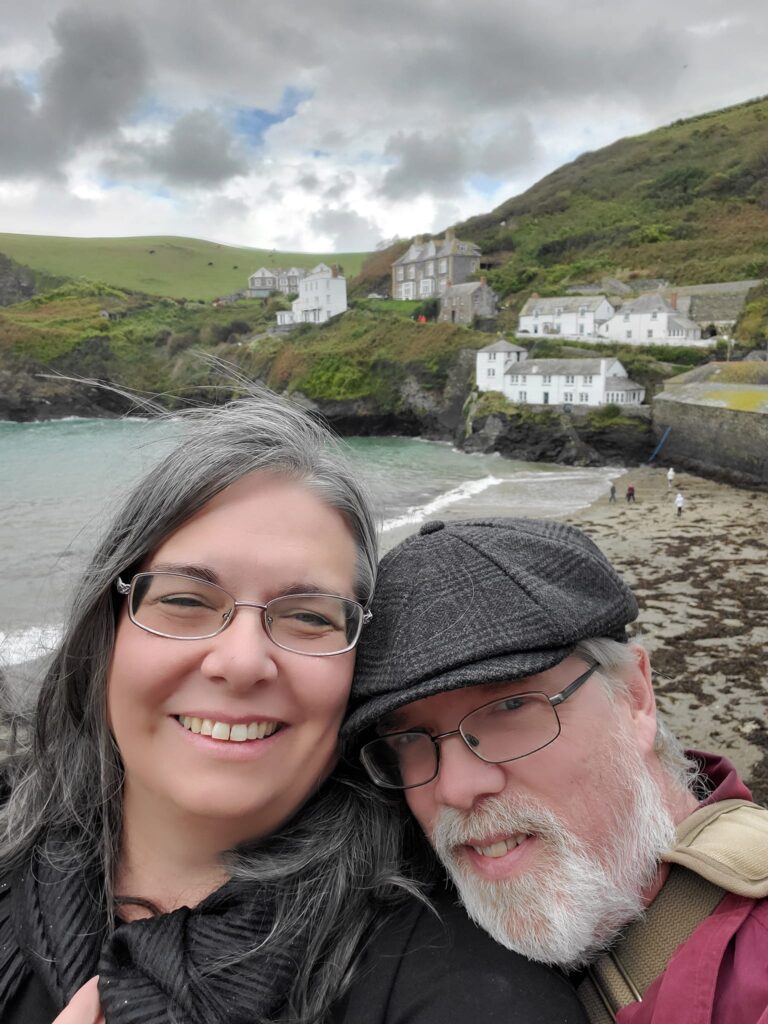
We opted for a paid tour of Port Isaac with Mike, who has been an extra in several episodes of Doc Martin and in Poldark. It was worth every dime to get the inside scoop from someone who had been actively a part of the show. We got to see the places that you can’t find when wandering on your own and hear about the history of the town and the show. This is also where we discovered Fisherman’s Friends and have since seen them in concert.
Tintagel is not King Arthur’s castle (Camelot) but it is the castle in which he was conceived. Tintagel was beyond magical, and we have to go back. We did not see everything while we were there – it’s an intimidating climb through the ruins, but being in better health now, we want to go back. Even if you’re a sceptic of the King Arthur mythos, Tintagel gives off a legendary feeling.


Whisperings of King Arthur had existed in Wales for centuries, but it wasn’t until Welsh cleric Geoffrey of Monmouth wrote his Historia Regum Britanniae that the legend was popularized. His account of British history placed the legendary king’s birthsite in Tintagel, Cornwall (known as Tre war Venydh in Cornish). Richard, 1st Earl of Cornwall, knowing this, had Tintagel Castle built to create a physical connection between the area and its supposed history. Now, in modern days, Historia Regum Britanniae is largely known as pseudohistory and if King Arthur existed, his connection to Tintagel and its castle are contested. All the same, the legend has made Tintagel a fascinating place for fans of British legend and mythology to visit.
Earls after Richard weren’t interested in use of the castle. Following a subsequent but brief use as a prison, it was left to ruin. Nowadays, there is a movement to restore some of the legacy in the area, and the ruins have been opened for tourism. The area was likely used as a summer residence for kings of Dumnonia, long before Cornwall was established. There, mythology fanatics can also see Gallos, the famous King Arthur statue. Beneath what was once Tintagel Castle, tourists can walk the 100m (330ft) length of Merlin’s Cave and come out the other side. Tintagel is also home to King Arthur’s Great Halls, a small building dedicated to Arthurian legend, which contains artwork and stained glass windows all dedicated to the historic king.
Tintagel, though quaint on the surface, is a hidden gem in Cornwall tourism, and a must-see for fans of the tales of King Arthur. As its legacy continues to be restored, there is more to see and more reasons to visit. Whether or not based on historic fact, Tintagel is a living tribute to the legacy of King Arthur that has been built up over the centuries, and the village is proof of the legend’s impact on British culture even in modern times.
Back in Exeter for our final night, the city felt different than it had on the first evening. We were both deeply satisfied with our experience and very sad it was coming to an end, already promising ourselves we’d return.
Day 5 – From Bath to Bath
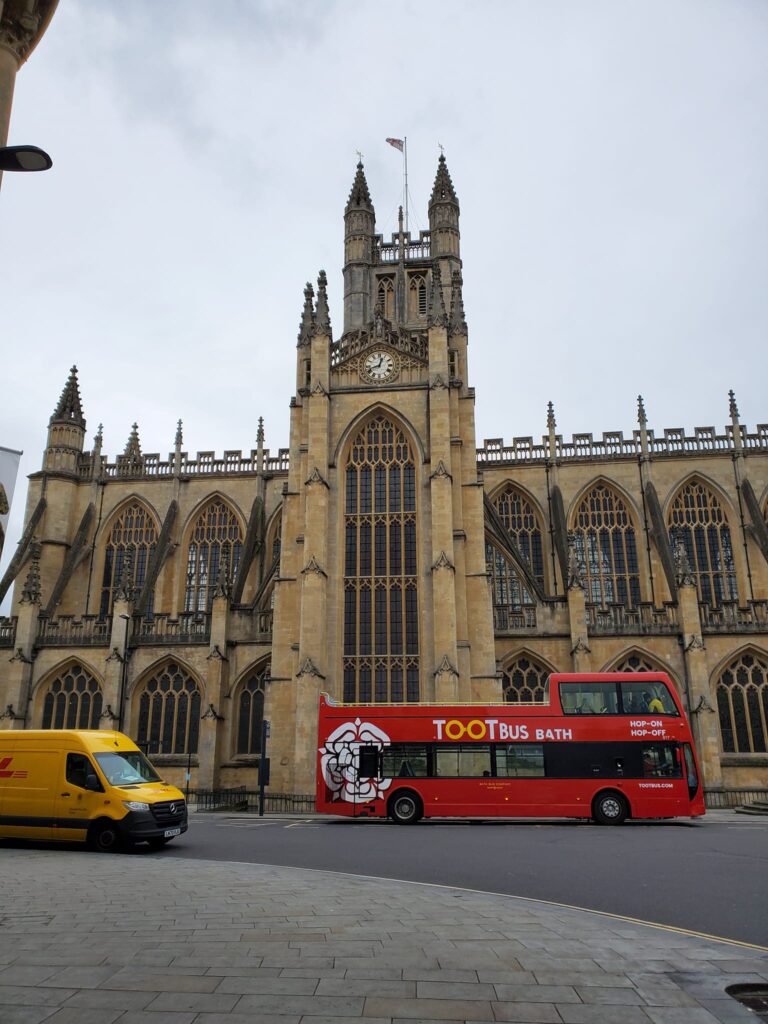
As a couple of Americans from Bath, New York, arriving in Bath, England made us feel connected. We opted not to explore the Roman Baths other than a quick view of the outside but instead spent our time walking, people watching, and visiting the historic Pulteney Weir and Pulteney Bridge (our Bath has a Pulteney Park). And as lit geeks, we were both pretty excited that Both Jane Austen and Mary Shelley wrote books in Bath!



The Cotswolds is a hilled area in Southwest England populated by manors and castles that are remnant of its medieval history. The Sudeley Castle is a beautiful estate complete with gardens, open to the public for visits, weddings, or other events. Other estates open for visiting include the Chavenage House, the Woodchester Mansion, or Owlpen Manor, although this is just the tip of the iceberg. The architecture of the Cotswolds is a main draw and there are many ways to take it all in. As we were only there for a quick stop, we simply took a moment to enjoy the surreal beauty.
The Cotswolds were every cliché made real: rolling hills, sheep in fields, and villages so picturesque you almost expect someone to shout “Cut!” between scenes. Castle Combe, in particular, looked like it had been carefully arranged with stone cottages, a little river, and not a modern eyesore in sight. It was pouring rain, but we wandered into St. Andrews Church and discovered Castle Combe Clock – a faceless clock from the 15th century that still works.


Driving back into London, the traffic and noise felt louder than they had five days earlier, but our trip had been absolutely divine.
We were privileged to have such a fabulous tour guide, jazz singer David Tughan. The pandemic interrupted his true calling as an entertainer, and we were spoiled by it. Be sure to check out his work.
History of Cornwall
Cornwall, or Kernow in Cornish, is one of the six regions in the United Kingdom that is widely considered to be Celtic country. Despite being a ceremonial county in England, it is remarkably different from the rest of the country. Everything from the town names to the Head of State are unique to Cornwall itself. Perhaps one of the reasons for this is due to the fact that the Romans had a negligible presence in Cornwall, compared to the Romanization that the rest of England went through. In this sense, Cornwall perhaps has more in comparison to nearby country Wales than the rest of England.
Although the Cornish language died out in the late 18th century, there has been a movement to revive it in recent years. Even for those who don’t speak the language, the Cornish dialect of English is different enough from its counterparts across the country that visitors could find it difficult to understand someone from Cornwall who speaks purely in Cornish English. Cornwall is also one of two still existing duchies in England, the other being Lancaster. Its ruler is the Duke of Cornwall, rather than the King of England.
Cornwall Today
In present day, Cornwall is a popular tourist destination among the English and foreign visitors alike. Between its beautiful seaside scenery and relaxing beaches, Cornwall is a commonly visited destination even without the metropolitan nature of places like London or Liverpool. The rich culture and picturesque landscape gives Cornwall about five million visitors a year, making it one of the UK’s top holiday destinations. As a result, many different travel guides and tour companies exist to take tourists through the county.
One of our favorite adventures!