
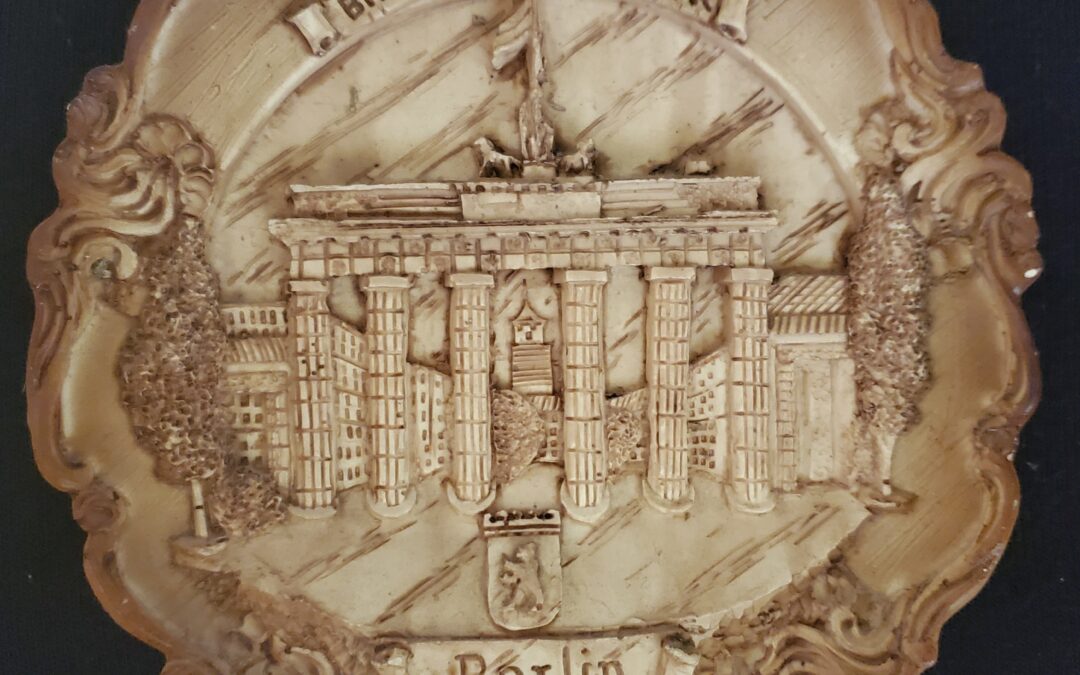
Berlin has long been an important city in German history, having been the capital of all its iterations since the year 1417. It has the largest population of any city in the European Union, and is a global city, having made significant contributions to culture, economy, and science. That said, many people who go to Berlin visit because of the storied history that exists there, and the presence of German culture that permeates through all the streets.
The first time we were in Berlin was while we were on our honeymoon in 1999. It was only 10 years after the wall came down, and you could stand at Checkpoint Charlie and look left and still see the drab, underdeveloped East Berlin and look right and see a thriving West Berlin. The city was no longer divided, but it was still recovering. When we returned in 2016, it had transformed dramatically.

Dave and Shadra, Brandenburg Gate, 1999

Dave and Shadra, Brandenburg Gate, 2016
Of all our travels, Berlin stands out as one of the most memorable cities we’ve ever visited. We are planning to return soon – there is still so much more to see. When we were there in 1999, we were part of a Contiki tour, and we had a tour guide in Berlin from Toronto. He was brilliant and truly brought the history of the city to life. I remember standing at Bebelplatz, the memorial to the May 10, 1933 book burning and just getting shivers from the thought that we were standing at such an important place in history. It was one of the places we were most determined to return to when we brought our youngest kids with us in 2016. (It was difficult to find; map to Humboldt University – it’s directly across the street).


Nazi Germany is undoubtedly the elephant in the room when speaking of Germany’s history, and no visit to Berlin would be complete without visiting some of the memorials that exist to commemorate the lives lost during the Holocaust. The nation of Germany has certainly put in the work to make certain that the era is remembered and reviled, and it’s a somber experience to walk through the bluntly titled Memorial to the Murdered Jews of Europe, coming face to face with such a dark side of humanity. The Jewish Museum in Berlin also allows tourists to learn about the history of the Jewish people in Germany. It takes visitors on a journey from the Middle Ages to the present day and is the largest Jewish museum in all of Europe.


After World War II, the city of Berlin saw itself become a centerpiece in the Cold War between the United States and the Soviet Union. Being split into two countries, West Germany would go on to establish a capitalist republic similar to many western countries. East Germany would see a lot of influence from the Soviet Union, who was their greatest sponsor throughout the Cold War. The people of East Germany suffered from great hunger and poverty, and oftentimes would escape the oppression by fleeing to West Germany. To prevent this, the Berlin Wall was erected, cleanly dividing the two sides of Berlin.


People still did escape, even despite border guards there to shoot people who tried. Checkpoint Charlie was the name given to one of the most common crossing points of the wall. The wall was taken down in 1989, and Checkpoint Charlie mostly removed to make way for offices and shops. That said, however, both are still some of Berlin’s most popular tourist attractions, due to the history. Visitors can still see the remains of the Berlin Wall around the city, and there are some segments at the Allied Museum.


Even without some of Berlin’s more tragic history, the city still has plenty to offer. Although it hasn’t been that long since Berlin’s darkest period, today it thrives. Tourists can visit art museums such as the Hamburger Bahnhof or the Berlinische Galerie. They can purchase street food such as bratwursts or pomme frites from local vendors. A testament to Germany’s resilience is Potsdamer Platz. Once divided in two by the Berlin Wall, it now is a bustling tourist area, with several things to do for fun, from shops and restaurants, to casinos and theatres. Just north of Potsdamer Platz is the Brandenburg Gate. Once barricaded by the Berlin wall, the neoclassical gate is now considered a symbol of unity, not just in Germany, but in all of Europe.

If there were ever living proof of the human ability to recover from the lowest of lows, it would be the city of Berlin. It’s a city that one could live in and still not see everything, so there is no shortage of things to do for someone stopping by for a visit. It’s a city full of somber reminders of the past, but also full of joy and hope that things will improve. Whether someone decides to enjoy the ever present culture of Germany or take a step into its history, there is sure to be something fun for anyone who chooses to visit.
How we got here: Eurail Pass
Where to stay: We chose to stay in a vacation rental so that we could prepare some meals at home.
Where to eat: Our favorite restaurant, Stadt Klause, closed. But the imbiss stand at Brandenburg Gate has amazing curry wurst.
Tips: You will never see it all in one trip unless you can live there for a month, but at the very least, we recommend Bebelplatz, Brandenburg Gate, the Berlin Wall Memorial, and Memorial to the Murdered Jews in Europe.
